Friday, September 18, 2026
Meeting Room No-Show Policy: Template and Release Rules

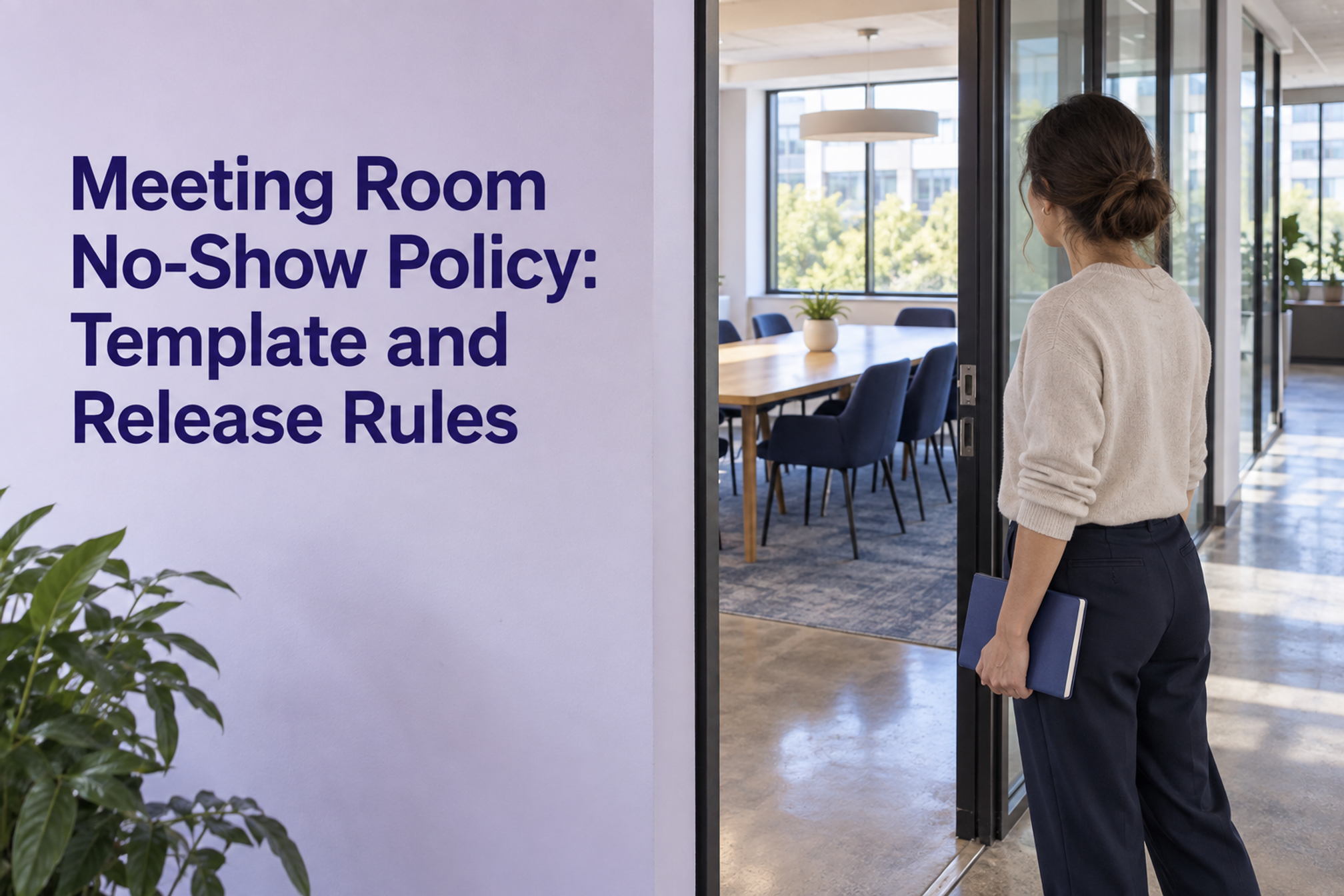
A meeting room no-show policy should say when a reservation can be released, what confirms that decision, who can make it, and how the next team books the space. Set a clear check-in or confirmation window, provide a fallback when it fails, and require the booking calendar to show availability before someone else takes the room.
Use the template below for shared office meeting rooms. It is designed for workplace operators and team leaders who need a usable rule for an empty-looking room, a late organiser, or a failed check-in. Adapt the bracketed fields to your actual booking system before sharing it.
First, separate a no-show from a missed check-in
For this policy, a confirmed no-show means the booked group did not use the room during the period you checked. A missed check-in means the expected confirmation did not arrive. Record those separately: a failed panel, a colleague who missed the instruction, or a meeting already underway can produce a missing check-in without proving non-use.
Also distinguish a cancellation from a release. The organiser may remove the room because the meeting has moved online. Alternatively, a booking system or authorised room owner may release the room under an agreed rule. Either way, make the change visible in the shared booking record.
Keep the meeting and the room reservation separate in your instructions. A team may still need its call, agenda, and attendee invitations after losing the physical room. Test what your system changes before enabling any automatic action.
Copy-and-use meeting room no-show policy
Complete every bracketed field. Choose one release method per room group, and remove options you do not support. This is an operational template for shared rooms, not a disciplinary policy.
Scope and confirmation
- Rooms covered: [room names or room group]. Exceptions: [special-purpose rooms or none]. Policy owner: [role and contact]. Effective date: [date].
- Booking record: use [calendar or booking system] for reservations, cancellations, and room changes. A message to a colleague does not update that record.
- Confirmation: an attendee using the room confirms the booking through [tested check-in method]. If the organiser is remote, [on-site attendee or named delegate] handles confirmation.
- Deadline: confirmation is due by [number] minutes after the reserved start time. Any permitted early confirmation follows [system rule]. Book setup time explicitly when the room is needed before the meeting.
Choose the release method
- Automatic release: for [enabled rooms], the system releases the reservation when the confirmation window expires without a valid check-in. Use this clause only after checking the actual trigger, notifications, exceptions, and supported room configuration.
- Manual release: for [manually managed rooms], [authorised role] checks room use and contacts the organiser through [channel]. If the room is unused, the deadline has passed, and no exception is recorded, that role releases the reservation in [booking system].
- Rebooking: another group may use the room after the booking system shows it is available and accepts their new reservation. An empty-looking room or an unanswered message alone does not give permission to take it.
Changes, faults, and exceptions
- Plans changed: remove the room as soon as you know it is no longer needed. If the meeting continues elsewhere, preserve the attendee event and joining details using the tested room-change workflow.
- Late arrival: contact [room owner] before the deadline where possible. A message does not extend a reservation unless the owner confirms and records an exception. After release, book an available space again.
- Check-in failure: use [fallback contact or method] immediately. The room owner confirms use and protects the reservation through [tested override]. If the release cannot be prevented, the owner resolves the calendar conflict before assigning the room again.
- Protected bookings: record [approved exception types] through [process] before the meeting. Name an owner and an end time for each exception; do not rely on an informal standing hold.
- Recurring bookings: [series owner] reviews the room requirement at [interval]. Remove unused occurrences or the series when appropriate. Repeated issues trigger a conversation about the booking or check-in process with [room owner].
Short version for booking instructions
Confirm your room through [method] by [deadline]. Cancel the room if your plans change. If confirmation fails, contact [owner]. Only use a released room once [booking system] accepts your reservation. For a late arrival or exception, get the room owner's confirmation rather than assuming the room is still held.
What to do when a booked room looks empty
Use this decision guide alongside the policy. It is intended for ordinary shared rooms covered by your release rule.
- Check the current booking. Is this the correct room, date, and start time? Has the booking already been cancelled, moved, or replaced?
- Check use without interrupting confidential work. If people are using the room, do not treat a missing check-in as permission to displace them. Ask the room owner to resolve the record.
- Check the deadline and exceptions. Before the deadline, or while an approved exception applies, the reservation remains protected under your policy.
- Follow the configured release route. Wait for automatic release, or ask the authorised owner to complete the manual check and calendar update. If the system state is unclear, use the fallback contact.
- Book the available time. Confirm that the new reservation is accepted and ends before the next booking. Do not silently extend into the next group's slot.

The key handoff is from a released reservation to an accepted new booking. Give one role responsibility for resolving any disagreement between the room's actual use and its calendar state.
Choose the window and trigger deliberately
There is no single grace period established by the sources below as best for every office. Consider your meeting lengths, setup needs, visitor arrivals, and the time people need to complete the supported confirmation step. A window that consumes much of a short booking leaves little time to reuse the room.
Microsoft documents a 10-minute default for its room autorelease policy, with a configurable window. That is a product setting, not a universal workplace standard. Its room check-in documentation also describes licensing and device conditions and recommends providing suitable room devices so users can check in.
Write down the actual trigger your tools use. Google's documented Calendar room-release feature acts when all but one person declines a meeting, subject to edition requirements and other conditions. That decline-based feature is different from detecting that nobody arrived at the room.
Zoom's workspace check-in guidance describes releasing a reservation after a configurable missed check-in window when the feature is enabled. It also explains that an early checkout shortens the calendar event and makes the unused time available. Check the configuration for the workspace type you actually use.
A useful setup note has five fields: room group, release trigger, confirmation method, exception owner, and fallback. If any field is unclear, resolve it before advertising automatic release to staff.
Test six situations before rollout
Run these checks with ordinary attendee permissions and the room equipment people will use. Record what happens in the booking calendar as well as at the door.
- An on-time attendee checks in: the reservation stays in place and its status is clear.
- Nobody confirms: the chosen release happens after the configured window, the expected notification arrives, and a second group can book the remaining time.
- The organiser is remote: an eligible on-site attendee can confirm through the agreed method.
- The panel or connection fails: the fallback reaches someone who can protect or resolve the reservation. Test the override, not just the contact details.
- The previous meeting overruns: the arriving group can follow your confirmation process without losing its booking while waiting. Escalation goes to a named owner.
- A protected or recurring booking is involved: the intended exception works, and releasing one occurrence does not unexpectedly remove later meetings or attendee invitations.
Where a test fails, change the room configuration or the policy wording and repeat it. Keep affected rooms on a clear manual process until the automatic path is dependable. For audio, participation, and meeting setup, use the separate hybrid meeting checklist.

Worked example: the organiser arrives after release
This is a fictional example, not a recommended grace period or a measured customer result.
A room is reserved from 10:00 to 10:30. The office has chosen a ten-minute confirmation window for this room group. Nobody confirms, and the system releases the reservation at 10:10. A second team receives an accepted booking for 10:10 to 10:30.
The original organiser arrives at 10:12. Under the published rule, the second team's accepted booking stands. The room owner helps the original group find another available space or join remotely. The late arrival does not silently restore the old reservation.
Now change one fact: the original team was already inside, but the check-in panel failed. Treat that as a release error to resolve, not a confirmed no-show. The room owner checks what happened, helps both groups find a workable arrangement, and fixes the failed confirmation route before repeating the rollout.
Review room access, not just release counts
A release count tells you that reservations were removed under a rule. It does not by itself show that the rooms were unused, that another team used them, or that work improved. Keep those questions separate when reviewing the policy.
Use this compact record for each issue or sampled release:
- Booking reference, room, scheduled time, and applicable rule.
- Trigger observed: organiser cancellation, missed check-in, or manually confirmed non-use.
- Release time and whether the organiser received the expected notice.
- New reservation accepted: yes, no, or unknown.
- Subsequent room use confirmed: yes, no, or not observed.
- Error or exception: occupied room released, failed confirmation, late arrival, or other issue.
- Follow-up owner and change to test.
Do not label every auto-release a no-show, or every rebooking recovered productive time. Use the occupancy and utilization definitions when you need a broader space report. Keep meeting titles, participant details, and sensitive discussion content out of a shared operational summary unless they are needed to resolve the issue.
Review a mix of busy and quieter office days. If rooms are still difficult to find, examine the room types and time slots people need, recurring holds, and actual overlap before assuming the grace period should be shorter.
Connect room planning to the office day
A reliable room-release rule is only one part of a useful shared day. Agree who needs to be together and what they need to do, then reserve a suitable room. The team office-day agenda can help connect the booking to a clear outcome.
Officedays office-day planning lets colleagues share planned office days in Slack and supports scheduled weekly prompts. Use that visibility to coordinate who is coming in, while keeping room reservations and release rules in the system responsible for the rooms.
Sources and methodology
Checked on 18 September 2026. This guide combines current first-party product documentation with an original operational template. It is not an Officedays survey or an empirical estimate of no-show rates. The policy clauses, decision guide, tests, and fictional example are editorial recommendations to adapt and verify locally.
- Microsoft Learn, room check-in and autorelease, updated 25 August 2026. Used for the configurable release window, documented default, and implementation conditions.
- Google Workspace Help, release unused Calendar meeting rooms, updated 16 September 2026. Used to distinguish a decline-based trigger from an arrival-based rule.
- Zoom Support, workspace reservation check-in and checkout, modification metadata dated 8 September 2026. Used for configurable check-in and early-checkout behaviour.
These are global product documents, not population studies, so geography-specific samples and sample sizes do not apply. Features and eligibility can change. Verify the current documentation and your own room configuration before enabling a release rule.