Monday, August 31, 2026
Fixed vs Flexible Hybrid Work Schedules: How to Choose

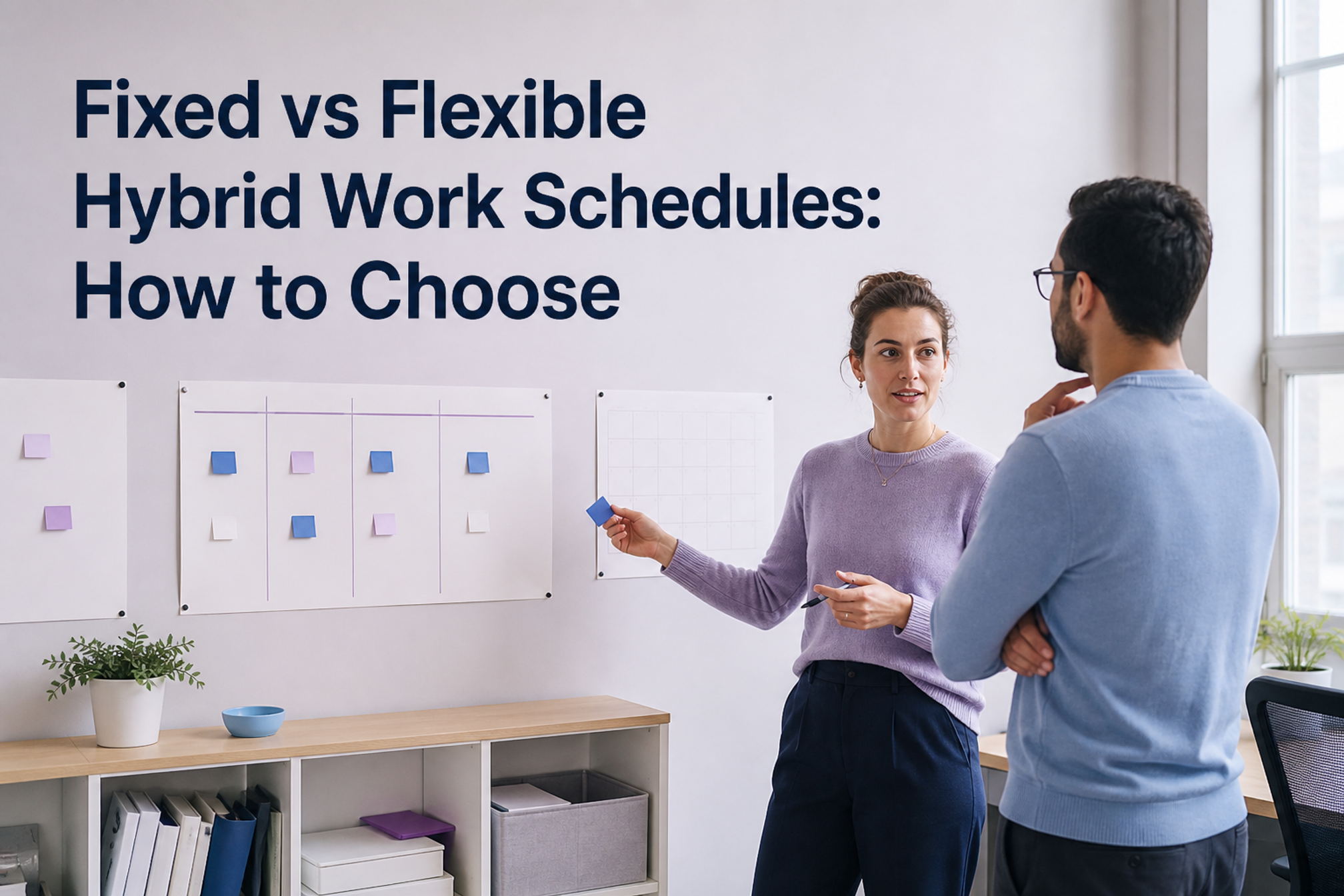
A fixed hybrid schedule assigns the same office and remote days each week. A flexible hybrid schedule lets people choose their office days within stated rules. Choose fixed when reliable same-day overlap, operational coverage, or space predictability matters most. Choose flexible when work patterns change and people can coordinate their own overlap. Many teams will land between the two: one shared office day plus one or more days chosen by each person.
These are established categories, not Officedays labels. The Slack hybrid schedule guide describes fixed schedules as consistent office and remote days, and flexible schedules as allowing employees to pick their office days. The Australian comparison guide uses the similar terms Fixed Split and Flexible Split. Our hybrid work glossary explains the surrounding vocabulary.
Real workplaces use both. In a Baltimore metropolitan region survey fielded in 2024, 727 hybrid workers answered a schedule question. Of that subset, 38% reported a fixed schedule, 51% a flexible schedule they selected, and 11% a flexible schedule assigned week to week. Treat the Baltimore survey result as regional context, not a universal benchmark.
Fixed vs flexible hybrid schedules at a glance
The number of office days and the way those days are chosen are separate decisions. A two-day schedule can be fixed, flexible, or partly coordinated.
- Office-day choice. Fixed: the organisation or team names the recurring days. Flexible: each person chooses within documented limits.
- Predictability. Fixed: the baseline is known well ahead. Flexible: predictability depends on a firm update deadline and visible plans.
- Team overlap. Fixed: overlap is reliable only when the people who need one another share the same fixed days. Flexible: overlap must be coordinated deliberately.
- Individual discretion. Fixed: lower day-to-day choice. Flexible: more choice over which eligible days to attend.
- Space planning. Fixed: easier to forecast, but common days can create peaks. Flexible: demand can spread out or bunch up, depending on how people choose.
- Change handling. Fixed: exceptions sit outside the usual pattern. Flexible: changes are expected, but still need a cutoff and correction process.
A study of office access data from 17 agile teams found substantial variation in co-presence. High average office presence did not necessarily mean teammates met often in person. That is why this comparison focuses on who overlaps, not only how many people attend.

Use this six-question decision matrix
Answer each question for one team, not for the whole organisation by default. Mark F when the fixed description fits better, X when the flexible description fits better, or B when both matter. This is a discussion aid, not a validated assessment instrument.
1. How recurring is the need for same-person overlap?
Mark F when the same people need to work together in person every week. Mark X when in-person collaborators change with projects or customer work. Mark B when one recurring group needs overlap but other office time can vary.
2. How much on-site coverage must be guaranteed?
Mark F when a reception, lab, client service, equipment, or facilities duty needs predictable coverage. Mark X when work is mostly location-independent and coverage can be arranged separately. Mark B when a small rotating group can cover the on-site need.
3. How early must space demand be known?
Mark F when rooms, specialist spaces, parking, or desks require long lead times. Mark X when capacity is generous and plans can settle closer to the day. Mark B when only peak events require advance booking.
4. How much does the work pattern change week to week?
Mark F when the team has a stable operating rhythm. Mark X when field work, launches, travel, or project stages change the useful office days. Mark B when one recurring rhythm sits beside variable work.
5. How much individual choice is needed?
Mark F when the role already has narrow location constraints and the recurring days are workable for the team. Mark X when people need meaningful choice and the work can support it. Mark B when a shared day can coexist with personal choice on other days.
6. How costly are late changes?
Mark F when a late change can cancel a session, leave a duty uncovered, or waste a booked resource. Mark X when colleagues can adapt asynchronously with little disruption. Mark B when only named events require firm attendance.
How to read the result
- Four or more F answers: test a fixed baseline, with a clear exception path.
- Four or more X answers: test a flexible schedule, with a planning deadline and an overlap check.
- Mostly B answers or a close split: test coordinated flexibility, such as one shared day plus one chosen day.
The score identifies a sensible starting model. It does not decide which weekdays, how many office days, or which roles are eligible. Those choices need their own evidence and consultation.
Copy-and-use schedule specification
A label such as fixed or flexible is incomplete until the operating rules are visible. Copy this specification into your team agreement or planning document.
- Team and scope: [people, roles, office, and start date]
- Schedule model: [fixed, flexible, or coordinated flexible]
- Office pattern: [named days, minimum days, or eligible window]
- Purpose of office time: [specific activities that benefit from co-presence]
- Required events: [events that override the usual pattern]
- Planning deadline: [when next week or month must be shared]
- Change process: [where to update a plan and by when]
- Exception path: [owner and private route for individual circumstances]
- Space rule: [what happens if planned demand exceeds usable capacity]
- Review date and owner: [date, decision maker, and evidence to review]
Fixed example
Product team, Sydney office. Tuesday and Thursday are the recurring office days. Tuesday is for planning and cross-functional reviews; Thursday is for pairing, mentoring, and workshops. Plans are confirmed by 3 p.m. Friday for the next week. Changes go in the shared planning channel. The team reviews the pattern after four weeks.
Flexible example
Customer research team, Melbourne office. Each person chooses any two eligible office days per week. One day should overlap with a named research partner when a live synthesis session is planned. Next-week plans are shared by 3 p.m. Thursday. The team checks room demand and partner overlap on Friday.
Coordinated-flexible example
Operations team, Brisbane office. Wednesday is a shared team day. Each person chooses one additional office day based on coverage, project work, and personal constraints. A rotating owner checks Friday coverage and publishes the next-week view.
Run a four-week schedule pilot
A pilot should test a specific schedule rule, not ask whether hybrid work feels good in general. Four weeks is enough to expose ordinary planning friction, although it may not capture seasonal peaks, new-starter needs, or rare events. Extend the test when those conditions matter.
- Before week 1: record the current schedule rule, planned office days, critical collaboration pairs, usable capacity, and known exceptions. Do not set a target you cannot explain.
- Weeks 1 to 3: use the new schedule specification. Keep the rule stable, record corrections, and note where the plan fails to support the intended work.
- Week 4: repeat the operating rhythm, run a short pulse, and review the measures below with the team.
- Decision: keep the model, change one rule, or test the other model. Avoid changing several variables at once because you will not know what helped.
Pilot scorecard
- Plan completion rate: people who shared a plan by the deadline divided by people expected to share one.
- Critical-pair overlap: named collaboration pairs with at least one shared office day divided by pairs monitored. Use the office-day overlap worksheet to choose the pairs transparently.
- Peak demand: the highest planned on-site count compared with usable capacity. Keep planned attendance distinct from measured occupancy, as explained in the occupancy and utilization guide.
- Change load: number of schedule corrections after the deadline, grouped by operational cause rather than private personal detail.
- Three-question pulse: Did you know who would be present? Did office time support the work you planned? What one rule should change? Adapt the broader hybrid work survey questions only if you need deeper diagnosis.
Do not combine these signals into one weighted success score unless you can defend the weights. A fixed model can have excellent plan completion but poor team overlap. A flexible model can provide useful overlap but produce an avoidable capacity peak. Keep the trade-offs visible.

Common failure modes
Fixed schedule failures
- The same days are assigned to everyone, but the work that benefits from being together is never named.
- Teams share a company day but miss the external partners or cross-functional colleagues they actually need.
- Exceptions exist in practice but are hidden, so the published pattern becomes unreliable.
- Attendance is treated as a proxy for performance instead of a location signal.
Flexible schedule failures
- People choose too late for colleagues or workplace teams to plan.
- The team watches total headcount but not the overlap of specific collaborators.
- Required events, eligible locations, or minimum notice are left ambiguous.
- A nominally flexible rule becomes manager-dependent because the decision boundaries are not written down.
How to change the model without creating confusion
- Separate policy from schedule. The organisation may set eligibility and boundaries while a team sets its weekly operating pattern.
- Write the current rule and the proposed rule side by side. Include who decides, when plans are due, and how exceptions work.
- Name the effective date, pilot period, review owner, and decision at the end.
- Share examples for travel, leave, public holidays, customer visits, and late changes without exposing confidential reasons.
- For consequential employment, privacy, accommodation, or safety questions, obtain qualified guidance for the relevant jurisdiction and circumstances.
Make the weekly schedule visible in Slack
Whichever model you choose, the schedule only works when the current plan is easy to see and update. Officedays makes weekly office plans visible in Slack: teams can use scheduled prompts, mark office days in the channel, and keep the shared view close to the conversations where coordination happens.
Use the schedule specification for the rule, then use the weekly plan for reality. That distinction lets a fixed team handle an exception without rewriting its model, and lets a flexible team coordinate without removing all choice.
Sources and methodology
Sources were checked on 31 August 2026. We used first-party platform guidance, an Australian government commission guide, a regional council survey report, and a conference research paper. The decision matrix, specification, examples, and pilot scorecard are an Officedays operational synthesis, not a validated assessment instrument or a universal benchmark.
- Hybrid Work Schedule Guide for Teams, Slack. Publication date was not stated on the page. Used for the fixed and flexible schedule definitions and implementation considerations.
- Choosing Your Hybrid Work Model, National Mental Health Commission and Swinburne University of Technology, 2024. The guide integrates a nationally representative May 2022 survey of 1,000 working Australians, 25 stakeholder interviews, research reviews, and workshops. Used for model definitions, clarity, consultation, and trade-off context.
- Baltimore Metropolitan Council Post-Pandemic Trends, report dated 22 November 2024, prepared by WBA Research. Employee fieldwork ran from February to April 2024 in the Baltimore metropolitan region. The schedule split is based on 727 hybrid respondents within a total employee sample of 1,630.
- Understanding the Difference between Office Presence and Co-presence, Moe and colleagues, submitted 23 September 2023 and presented at HICSS 2024. The study examined access-card patterns for 17 agile teams in one large telecommunications company. Used to distinguish average presence from team co-presence.
The Baltimore figures describe one region and one survey period. The 17-team study concerns one company and does not establish a universal effect. No numerical keyword-volume data was available for topic selection, so search demand was assessed qualitatively from current query language and result patterns.