Monday, July 20, 2026
Hybrid Work Survey Questions: 30 Questions and Analysis Template

The best hybrid work survey questions separate what people did, what they prefer, which tasks fit each location, where coordination breaks down, and how clearly the current rules are understood. Ask about recent behaviour before opinions, use consistent response scales, and connect every question to a decision you are prepared to make.
This guide provides 30 copy-ready questions, a shorter 12-question pulse survey, exact response options, and a simple analysis template for People Ops, workplace teams and team leaders. It is an operational template, not a validated psychometric instrument or a substitute for specialist advice on sensitive employee research.
Start with the decision, not the questionnaire
A useful survey has a traceable chain: decision, question, response, action. A 2025 Survey Practice case study followed that logic through employee interviews, cognitive interviews and a field test before scaling its hybrid-workplace survey. The practical lesson is to define the decisions and work activities first, then test whether employees interpret the questions as intended.
Write one line beside every proposed question: “If the answers differ, what could we change?” Remove questions that have no plausible owner or action. This keeps a hybrid work survey focused on scheduling, workspace, communication and team coordination rather than collecting opinions for their own sake.

The diagram is also the article’s core method in accessible form: define a decision, ask one focused question, choose a response format that fits the decision, and name the action or follow-up before launch.
Use a survey structure that separates five signals
Start with recent behaviour. The ONS hybrid-work measures classify working arrangements from two questions about the previous seven days. That concrete reference period is a useful model because it distinguishes what happened from what someone usually does or would prefer to do.
- Actual pattern: where people worked during a defined recent period.
- Required pattern: what the organisation or team currently expects.
- Preferred pattern: what employees would choose for the next planning period.
- Task and coordination fit: which work benefits from each location and where plans fail.
- Policy experience: clarity, consistency and the next change worth testing.
Office-day expectations are already a live operating question. In the CIPD 2025 report, 65% of UK organisations that allowed hybrid working required a minimum workplace frequency. The employer survey included 2,050 HR professionals, while the report gives a base of 1,522 for the weekly minimum-days breakdown. This is context, not a benchmark that every team should copy.
30 hybrid work survey questions
Use only the modules linked to a real decision. Questions marked as optional open text are most useful when someone has time to read, code and respond to the comments.
1. Current work pattern and expectations
- 1. In the past seven days, on how many days did you work from an office or other employer-provided workplace? Response: 0, 1, 2, 3, 4, 5, or I was not scheduled to work.
- 2. In the past seven days, on how many days did you work from home or another remote location? Response: 0, 1, 2, 3, 4, 5, or I was not scheduled to work.
- 3. On which days did you work from an office or other employer-provided workplace in the past seven days? Response: Monday, Tuesday, Wednesday, Thursday, Friday, another day, or none. Select all that apply.
- 4. How many days are you currently expected to work on-site in a typical week? Response: 0, 1, 2, 3, 4, 5, varies by week, or I am unsure.
- 5. How clear are the current expectations about when you should work on-site? Response: not at all clear, slightly clear, moderately clear, very clear, completely clear, or not applicable.
2. Preferred pattern and planning horizon
- 6. During the next three months, how many days per week would you ideally work on-site? Response: 0, 1, 2, 3, 4, 5, or it depends on the week.
- 7. Which weekdays would you usually prefer for on-site work? Response: Monday, Tuesday, Wednesday, Thursday, Friday, no usual preference, or it depends on the work. Select all that apply.
- 8. Who should make the final decision about regular office days for your role? Response: individual, immediate team, department, organisation, shared decision, or unsure.
- 9. How far in advance do you need to see colleagues’ office plans for your own planning? Response: same day, one day, two to three days, one week, two weeks or more, or no advance notice needed.
- 10. How easy is it to change a planned office day when work or personal circumstances change? Response: very difficult, difficult, neither, easy, very easy, or not applicable.
3. Task and location fit
- 11. Where can you usually complete individual focus work most effectively? Response: mainly remote, mainly on-site, equally in either location, depends on the task, or not applicable.
- 12. Where can you usually complete planned collaborative work most effectively? Use the same response options as question 11.
- 13. Where can you usually resolve unplanned questions with colleagues most effectively? Use the same response options as question 11.
- 14. Where can you usually learn from or coach colleagues most effectively? Use the same response options as question 11.
- 15. Which activities would make shared office time most useful for your team? Response: planning or whiteboarding, onboarding or coaching, project work, client work, team connection, specialist equipment or space, another activity, or none. Select up to three.
4. Office usefulness and coordination
- 16. When I travel to the office, the colleagues I need to work with are usually there. Response: strongly disagree, disagree, neither agree nor disagree, agree, strongly agree, or not applicable.
- 17. Our shared office days are used for work that benefits from being together. Use the same agreement scale as question 16.
- 18. I can see colleagues’ office plans early enough to plan useful in-person work. Use the same agreement scale as question 16.
- 19. How often do office capacity, rooms, desks or equipment make an office day less useful? Response: never, rarely, sometimes, often, always, or not applicable.
- 20. Think of a recent office day that was less useful than expected. What was the main reason? Response: optional open text.
5. Meetings and information access
- 21. Remote participants can contribute to hybrid meetings as easily as people in the room. Response: strongly disagree, disagree, neither agree nor disagree, agree, strongly agree, or not applicable.
- 22. Decisions made in office conversations are documented where everyone can find them. Use the same agreement scale as question 21.
- 23. Meetings are planned with the expected mix of remote and on-site participants in mind. Use the same agreement scale as question 21.
- 24. I know where to update my plan when my work location changes. Use the same agreement scale as question 21.
- 25. Which barrier most often slows office-day coordination? Response: plans are not visible, plans change too late, the right colleagues do not overlap, rooms or desks are unavailable, hybrid meeting setup is poor, transport disrupts plans, no recurring barrier, or other.
6. Policy clarity and next action
- 26. I understand why our current hybrid work pattern exists. Response: strongly disagree, disagree, neither agree nor disagree, agree, strongly agree, or not applicable.
- 27. Current hybrid work expectations are applied consistently within my team. Use the same agreement scale as question 26.
- 28. Which single change would most improve your hybrid work experience? Response: earlier plan visibility, clearer purpose for office days, better hybrid meeting practice, more individual choice, better office setup, different shared days, no change, or other.
- 29. What should we keep about the current hybrid work pattern? Response: optional open text.
- 30. What should we change first, and why? Response: optional open text.
The 12-question pulse version
When the immediate decision is office-day coordination rather than a full workplace review, use this shorter set. Keep the wording unchanged between repeated pulses if you want to compare results over time.
- 1. In the past seven days, on how many days did you work from an office or other employer-provided workplace?
- 2. How many days are you currently expected to work on-site in a typical week?
- 3. How clear are the current expectations about when you should work on-site?
- 4. During the next three months, how many days per week would you ideally work on-site?
- 5. How far in advance do you need to see colleagues’ office plans for your own planning?
- 6. Which activities would make shared office time most useful for your team?
- 7. When I travel to the office, the colleagues I need to work with are usually there.
- 8. Our shared office days are used for work that benefits from being together.
- 9. I can see colleagues’ office plans early enough to plan useful in-person work.
- 10. Remote participants can contribute to hybrid meetings as easily as people in the room.
- 11. Which single change would most improve your hybrid work experience?
- 12. What should we change first, and why?
Carry over the response options from the numbered question bank. Add role, team or office only when the field is necessary for a decision and can be reported without exposing individuals.
How to analyse the results without hiding the signal
Keep behaviour, preference and experience as separate columns. A single hybrid satisfaction score can conceal very different operating problems. Report counts as well as percentages, show missing and not-applicable responses, and avoid comparisons between groups that are too small or too different in role requirements.
Four transparent calculations
- Office-day preference gap: preferred on-site days from question 6 minus actual on-site days from question 1. A positive value means the respondent prefers more office days than they reported; a negative value means fewer. Show the distribution, not only the average.
- Coordination friction rate: the share selecting disagree or strongly disagree for question 16 and question 18. Report the two items separately so colleague overlap is not confused with plan visibility.
- Office-purpose rate: the share selecting agree or strongly agree for question 17, excluding not applicable from the denominator.
- Policy clarity rate: the distribution of question 5, reported separately from agreement with the policy or preferred frequency.
These are transparent operational calculations, not population estimates or validated composite scales. If the survey is a census of a small team, describe that team only. If it is a sample, document how people were invited, who responded and what the survey cannot represent.
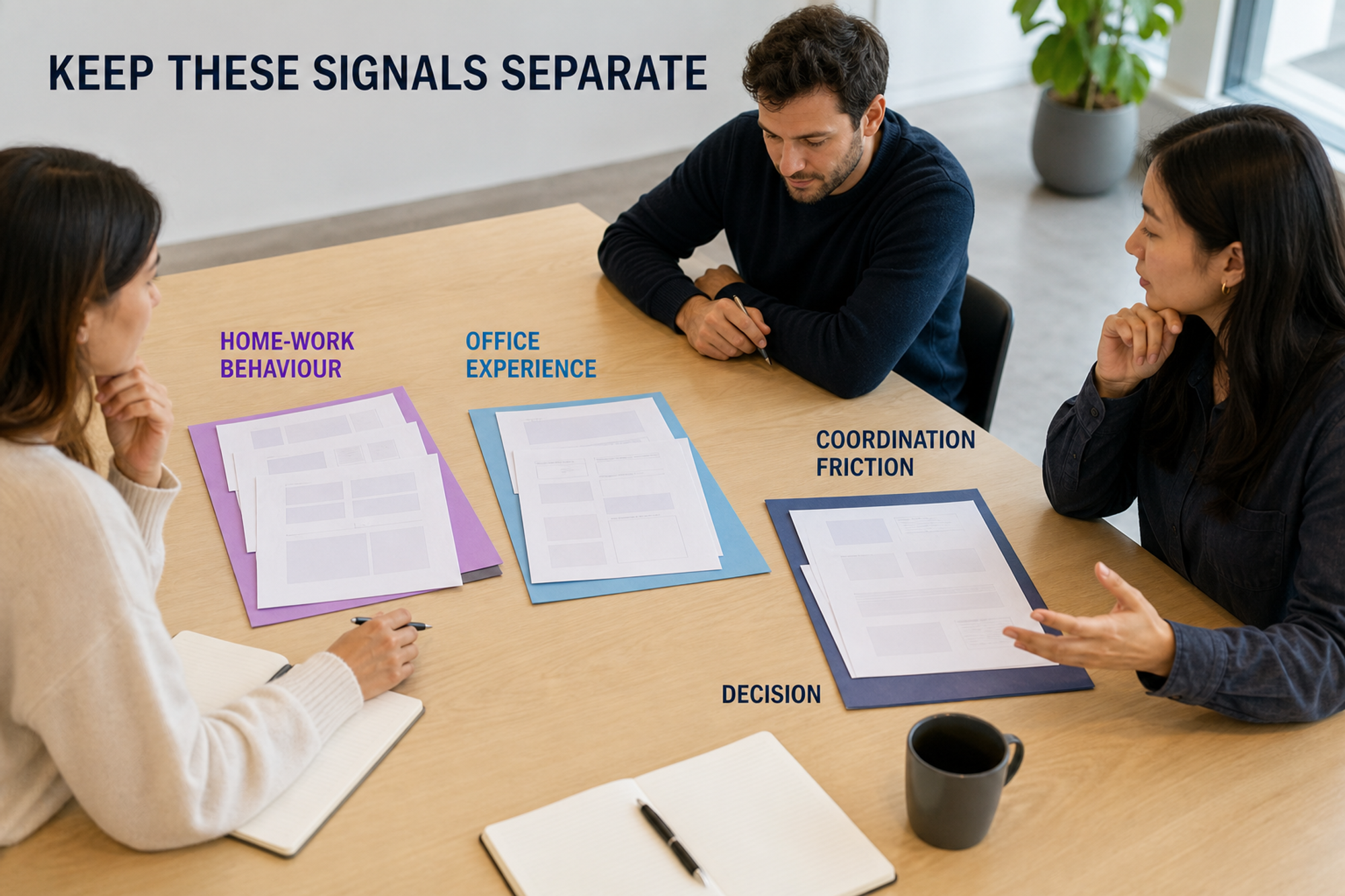
The image transcribes the analysis principle visually: home-work behaviour, office experience and coordination friction remain separate signals until the decision stage. Do not treat one location preference as a proxy for every task or every team.
Turn patterns into tests
- Preference and actual days differ, but policy clarity is low: clarify the operating rule before changing the number of days.
- Plan visibility is high, but office-purpose scores are low: redesign what the shared day is for rather than adding reminders.
- Task-location answers vary widely by role: test a team-based or role-based pattern instead of one company-wide schedule.
- Colleague overlap is low: use an overlap exercise before choosing shared days.
- Hybrid meeting participation scores are low: test meeting and documentation rules before changing attendance expectations.
Pretest before sending it to everyone
Pew Research Center’s questionnaire guidance explains that wording and question order can affect answers, recommends pretesting new questions, and advises keeping wording and context stable when measuring change. The Stats NZ survey guide likewise treats user testing and pilot surveys as parts of survey development, not optional decoration.
- Ask a few people from different roles to say what each question means in their own words.
- Check whether every response list contains the answer they looked for, including not applicable where needed.
- Run a small field test and inspect completion time, skipped items and repeated requests for clarification.
- Remove questions that do not change a decision or that the survey owner cannot act on.
- Explain who will see the results, how comments will be handled and when employees will hear what happens next.
Do not use this operational template to collect health, disability or other sensitive information without appropriate expertise and safeguards. Do not present it as an individual performance evaluation.
Copy-and-use survey introduction
We are reviewing how our hybrid work pattern supports individual work, team coordination and useful office time. This survey asks about your recent work pattern, the work that fits each location, and the changes that would help most. We will use the results to decide [name the decisions]. Responses will be handled as [describe the real confidentiality or anonymity arrangement]. We will share a summary and next steps by [date].
Replace every bracketed field before launch. If you cannot name the decision, privacy arrangement, owner and follow-up date, pause the survey and resolve those gaps first.
Connect the survey to a weekly operating rhythm
Use the results to update a team agreement template, then use the office-day planning worksheet to compare possible shared days. The Slack attendance tracker guide shows how to keep weekly plans visible after the policy decision.
Officedays lets teammates share planned office days and see colleague overlap in Slack. Check the Officedays support guide for the current workflow and Officedays pricing for plan details. Use it to coordinate declared plans, not to turn a planning survey into individual surveillance.
Sources and methodology
This article is an Officedays editorial synthesis and reusable operating template. It does not report original Officedays survey research, validated search volume, or a statistically validated scale. Sources were last checked on July 20, 2026.
- Survey Practice case study: Sarah Crissey, April 2025. The global workplace study used 87 foundational interviews, 17 cognitive interviews and a field test with 143 responses from 300 invited employees. We used it to shape the decision-first structure and pretest guidance.
- Pew questionnaire guidance: undated methods page, accessed July 20, 2026. We used its guidance on wording, order, open and closed questions, pretesting and stable trend wording.
- Stats NZ survey guide: fifth edition, 2019, accessed July 20, 2026. We used its survey-planning, question-design, user-testing and pilot guidance.
- ONS hybrid-work measures: released June 11, 2025, Great Britain. We used the previous-seven-days work-location questions as the model for separating recent behaviour from preference.
- CIPD 2025 report: issued July 2025. Its UK employer survey included 2,050 HR professionals, fielded online from April 14 to May 5, 2025. We used its minimum-workplace-frequency result only as context for why policy and actual behaviour should be measured separately.