Tuesday, November 17, 2026
Hot Desking Lockers: Assigned vs Day Use

Choose assigned hot desking lockers when people need to leave belongings between visits. Choose day-use lockers when storage is needed only during a visit and users can empty them before leaving. Use a mixed setup when both needs exist. Decide the storage duration first, then the allocation rules, capacity and locks.
This guide is for workplace and People Ops teams choosing a storage model for shared desks. It includes a decision checklist and a copyable storage brief. These are suggested planning tools, supported by examples of published workplace procedures, rather than universal locker standards.
Assigned vs day-use lockers: the practical difference
Assigned lockers: the same person keeps the allocation
An assigned locker stays allocated to one person across office visits. Your local rules determine what can remain inside, for how long, and when the allocation ends. This is a useful option for someone who needs to keep a permitted keyboard or other regular work kit at the office.
For a concrete institutional example, LSE’s blended working FAQs say staff without a dedicated campus desk receive a locker. The allocation normally lasts until they leave LSE or move buildings. That is LSE’s arrangement, not a rule every hybrid office needs to adopt.
The tradeoff is straightforward: an allocated compartment remains unavailable to other people even on days its owner works elsewhere. Define how allocations are reviewed when someone changes office, no longer needs storage or leaves the organisation.
Day-use lockers: the allocation ends with the visit
In this guide, day use means a person claims a locker for their visit, removes their belongings and releases it before leaving. Another person can use it after release. This can suit visiting colleagues or employees who bring their bag in and take everything home.
Publish the release rule in plain language. “Before you leave the office” may be clearer than “end of day” when people work different hours. Explain how someone working late can get help if a lock fails. Do not describe a locker as available until the previous user has physically emptied it.
Mixed lockers: separate the two promises
A mixed setup keeps some compartments assigned and others available for day use. Make the distinction visible in the allocation list and employee instructions. A person arriving for a day-use locker should not need to guess whether an apparently empty compartment belongs to somebody else.
Keep locker allocation separate from seating allocation. A person can have an assigned locker while using different shared desks. If you are also choosing where teams sit, use the office neighborhoods comparison to settle that decision alongside the storage plan.
Use these questions to choose a model
- Must anything stay between visits? List the actual items and confirm they are permitted. A day-use-only model needs another answer for items that must remain onsite.
- Who needs temporary storage? Include occasional visitors from other offices and people who normally work remotely. Identify how they will find and open a locker.
- Can every user empty a locker at departure? Ask about travel patterns, late finishes and work kit. Record exceptions before announcing a blanket release rule.
- Where do other items belong? Give coats, shared supplies and controlled documents their own storage routes when appropriate. Do not assume one personal locker must hold everything.
- Who runs the allocation? Name the person who assigns compartments, handles access problems, checks availability and updates the instructions. Test the process when that person is away.
If ongoing storage is the main need, start by assessing assigned lockers. If temporary storage is the main need, assess day use. If the answers divide by user or item, assess a mixed model. Treat this as a decision prompt, then test it with the people who will use the space.
Check the belongings, not just the locker count
WorkSafe Victoria’s storage guidance advises considering an item’s size, weight and frequency of use when deciding where to put it. Apply that planning principle to real bags and work equipment before choosing compartments.
Try the proposed storage with the items people expect to bring. Check whether the bag fits through the opening, whether the door closes, and whether users can retrieve frequently needed items conveniently. Ask users to try the lock and request an alternative arrangement where needed.
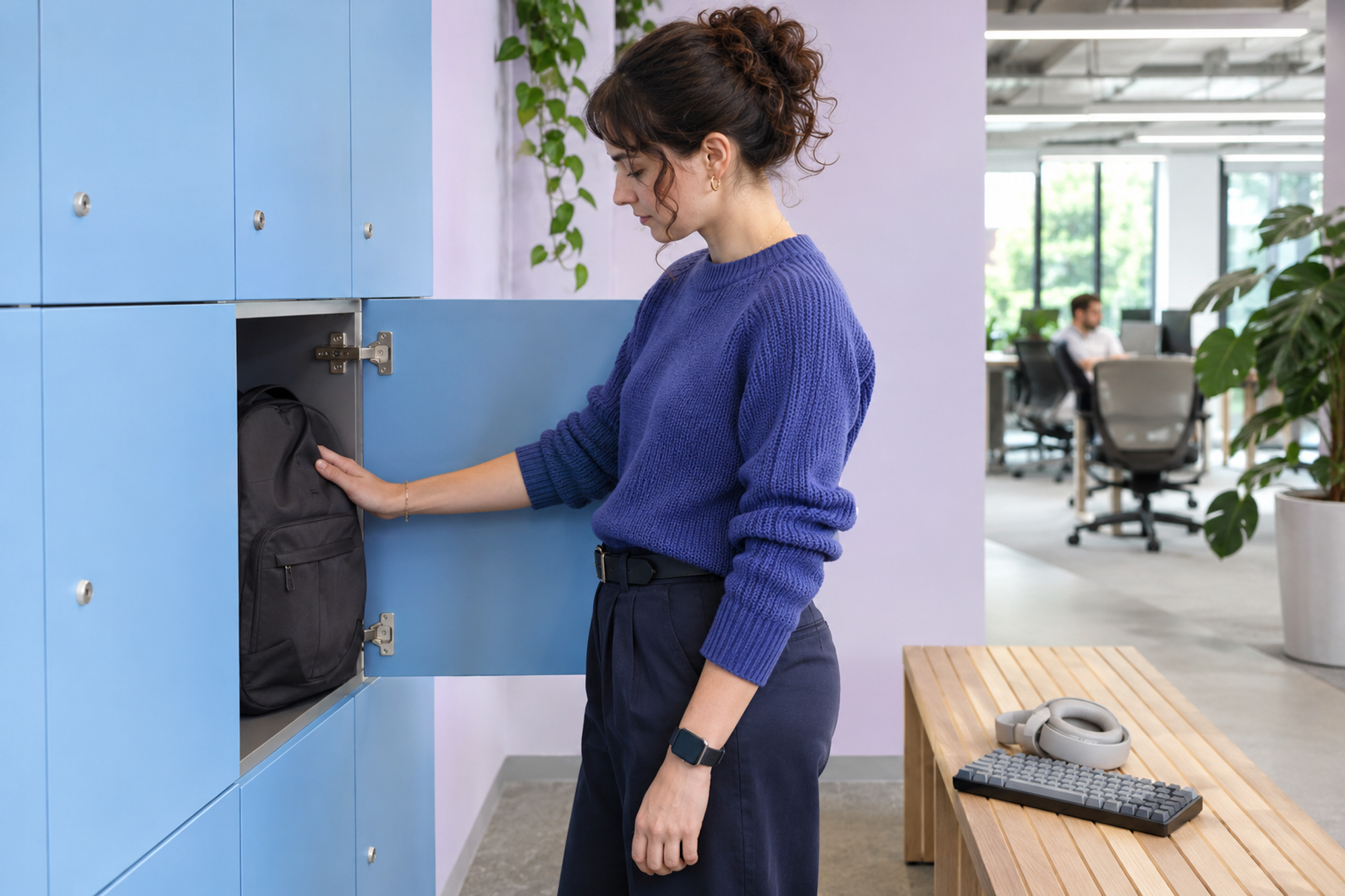
Some belongings need another destination. Victoria University’s storage procedure distinguishes personal storage, storage for people sharing desks, team storage and wet-weather areas. It is a useful example of planning several storage routes within one workplace, subject to that university’s own arrangements.
For your office, record where a wet coat, shared reference material and a personal backpack should go. Ask the relevant internal owner which storage is approved for laptops, batteries or confidential records. An ordinary locker should not be assumed suitable for every item.
Size the pools according to their different uses
Count assigned and day-use demand separately. An assigned locker is a continuing allocation, so a low-attendance day does not make it available to someone else. For the day-use pool, examine how many people need a compartment at the same time, including visiting colleagues.
Start with your planned office schedule and ask which attendees need temporary storage. Then test actual use on the days most likely to be busy. Record requests that could not be met, items that did not fit and lockers that remained occupied after the agreed release point.
If you need a way to structure weekday assumptions, adapt the office capacity planning worksheet. Keep the locker assumptions explicit: office attendance is an input to planning, not a count of people who need lockers. Choose an overflow arrangement and a review point instead of borrowing an unexplained locker-to-headcount ratio.
Copy this storage brief before choosing locks
Complete one brief for each office or locker area. The purpose is to give facilities, IT, office managers and employees the same operational instructions. Replace every bracketed field before sharing it.
- Location and owner: [office, floor and locker bank]. The allocation owner is [role/contact], with [backup] covering absences.
- Users and items: [who can use this storage] for [permitted belongings]. Items needing a different storage route are [items and destination].
- Allocation model: [assigned, day use or mixed]. Assigned compartments are identified by [method]; day-use compartments are identified by [method].
- Capacity and overflow: [usable compartments in each pool]. If no suitable locker is available, contact [role] and use [agreed alternative].
- Release rule: day-use lockers must be emptied [departure rule]. Assigned allocations are reviewed [trigger], with changes communicated by [owner].
- Access and recovery: use [key, code or credential process]. For a forgotten code, lost key, broken lock or after-hours problem, contact [route]. Access assistance follows [approved identity and authorisation process].
- Other storage routes: coats go [place]; shared equipment goes [place]; items controlled by other internal rules go [approved destination].
- Review trigger: review this brief on [date] and when [office move, attendance change, repeated overflow or other trigger]. The owner records [problem and action].
For access recovery, LSE’s access recovery process provides another specific example: its office manager checks Staff ID and the allocation list before opening a locker for a forgotten code. Use that as a prompt to define your own approved verification process. Questions about opening occupied lockers or handling unclaimed property belong with your organisation’s responsible policy owner before rules are issued.
Example: a team chooses mixed storage
Consider a fictional team whose members share desks. Some need to leave approved peripherals onsite between visits, while colleagues visiting from another office only need somewhere for a bag during the day.
The workplace lead assigns lockers for the continuing needs, keeps a separate day-use pool for visitors and gives shared supplies their own cupboard. The brief names an allocation owner and backup, explains departure release, and identifies an overflow contact. The team tests the arrangement on a busy office day before deciding whether to change the mix.
This is an illustrative choice, not a reported customer result. The useful distinction is the duration of storage, rather than whether someone has a permanent desk.
Make the daily handoff clear
Tell employees how to find an available locker, get access help and leave it ready for the next user. Ask them to report an occupied or broken compartment to the named owner. Put the instructions where someone arriving for the first time can find them.
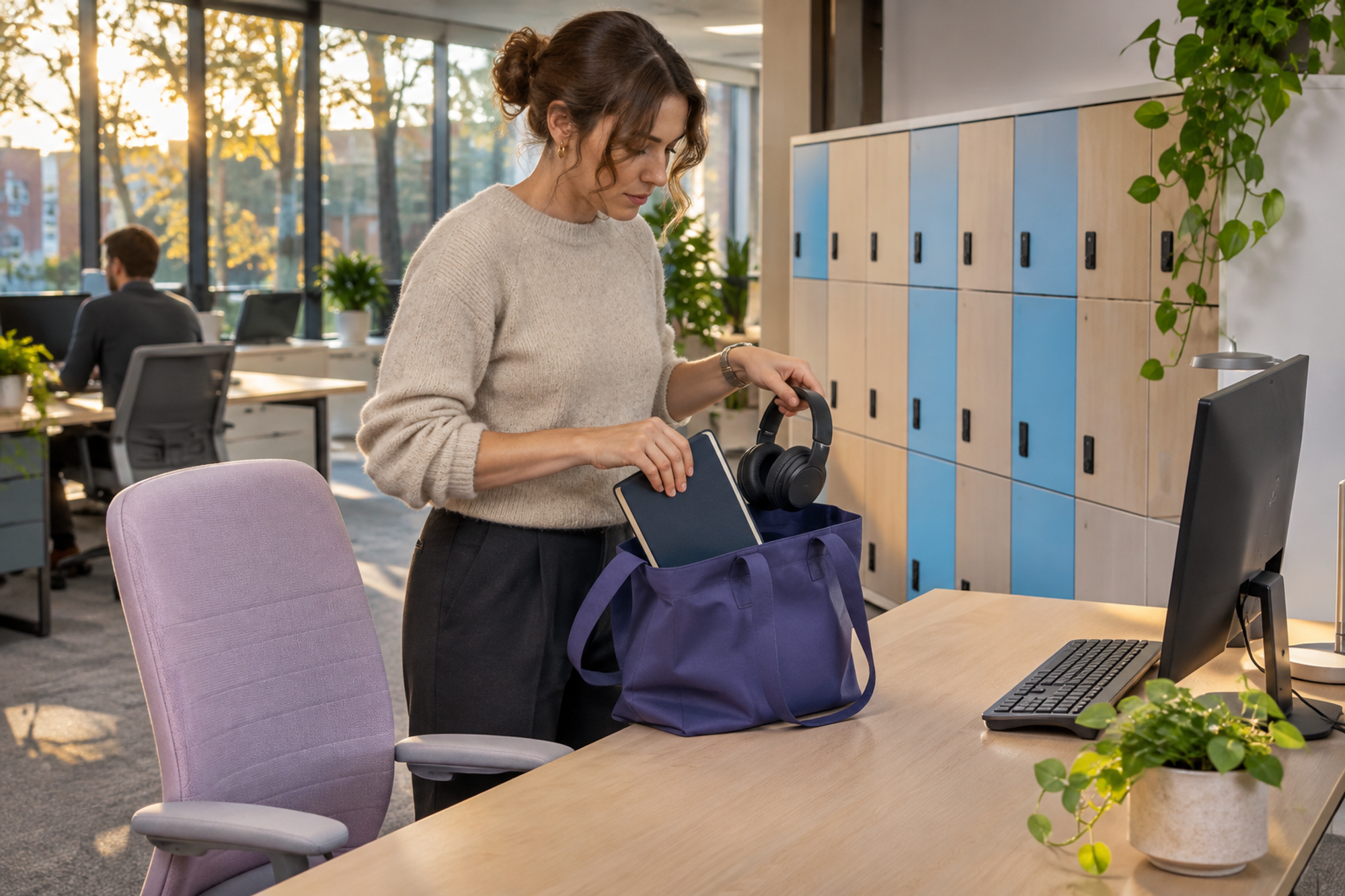
Coordinate the expected office day as well as the storage instructions. Officedays in Slack lets colleagues share planned office days and supports scheduled prompts. Those plans can inform the workplace conversation about likely busy days; locker allocation and access remain separate operational decisions.
Sources and methodology
Sources checked on 17 November 2026. This article uses published institutional procedures and official storage guidance as examples, not as evidence that one locker model produces better outcomes. The decision questions and storage brief are Officedays editorial tools. No survey findings, measured outcomes or universal capacity ratios are claimed.
- London School of Economics and Political Science: blended working FAQs, locker allocation and access recovery. No publication date is stated on the consulted FAQ page. Scope: LSE staff in the United Kingdom.
- Victoria University: Space Allocation and Management Procedure, Storage section. No publication date is displayed on the consulted main page. Scope: that institution’s facilities in Australia.
- WorkSafe Victoria: Using office stationery, software and storage systems, Lockers section. No publication date is stated on the consulted page. Used for item-based storage planning in Victoria, Australia.
These are guidance and procedure sources, so survey geography, sample sizes and study periods do not apply. Locker rules vary by workplace; confirm local storage, access and property-handling arrangements with their responsible owners.