Saturday, September 12, 2026
Office Quiet Zone Rules: A Practical Template

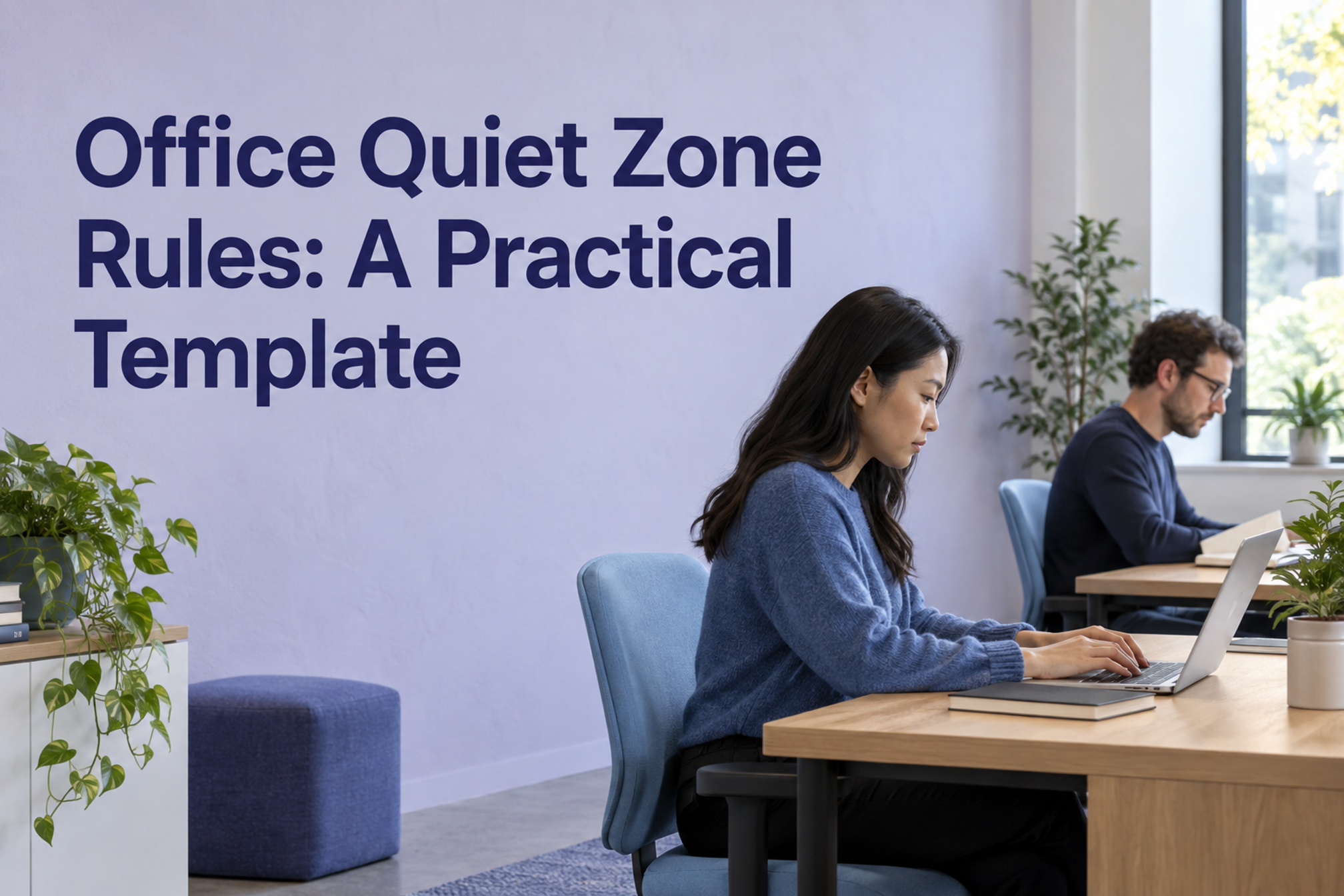
Office quiet zone rules should say what the space is for, whether speaking is allowed, where calls and conversations should move, how people get a seat, and who handles problems. A useful starting rule is simple: use this area for individual work, and move spoken conversations elsewhere.
The harder part is making that rule usable on a busy office day. A no-call area needs a workable call alternative. A focus desk needs a clear boundary. Someone who is interrupted needs a way to get help without becoming the office noise monitor.
Below is a copyable template for a shared focus area, followed by setup checks and answers to common edge cases. Adapt the wording with the people who use the space. The rules, examples, and review periods are Officedays editorial recommendations, not a universal workplace standard.
Define the space before writing the rules
For this template, an office quiet zone is a shared area for individual work where people do not hold conversations or join spoken calls. Ordinary working sounds, such as typing and moving a chair, still happen. Avoid promising total silence in an open office.
A quiet zone and a private call room serve different purposes. New Zealand's Government Property Office describes focus, ambient, and active zones and places several different settings within them, including phone booths and focus rooms. That makes local instructions essential: the word “quiet” alone does not tell someone whether a room permits a call.
Use these three descriptions when you show people around:
- Shared focus area: individual work; conversations and spoken calls move elsewhere.
- Call space: speaking is expected; check the room's booking rules and suitability for the conversation.
- Collaboration area: discussion and joint work are expected; follow the area's agreed noise rules.
Keep any existing wellbeing, prayer, recovery, or other dedicated rooms within their intended purpose. Do not casually rename them as overflow phone booths.
Copy-and-use office quiet zone rules
Replace every bracketed field before sharing this template. Choose a real alternative location for calls and a named owner who can resolve problems.
Purpose and access
- Purpose: [area name] is for individual reading, writing, analysis, and other work that needs limited interruption.
- Boundary: the rules apply to [desks, room, or clearly described area] during [days and hours].
- Access: seats are available through [walk-in use or the existing booking process]. Follow [local time limit, release rule, or no time limit].
- Availability: if no suitable seat is free, use [agreed alternative] or contact [owner]. Do not move another person's belongings.
Sound and interruptions
- Calls and conversation: take spoken phone calls, video meetings, voice messages, and discussions to [call space or collaboration area]. Headphones do not change this rule when you are speaking.
- Listening: use headphones for audio at a level that does not disturb nearby people. Join a listen-only session here only if you can remain silent; move before contributing aloud.
- Alerts: silence nonessential device sounds. Arrange any necessary audible alerts with [owner] in advance where possible.
- Questions: send a message or arrange a time to talk instead of starting a desk-side discussion. For urgent help, use [agreed urgent route].
- Everyday use: avoid unnecessary noise, but expect normal movement and working sounds. The area is not guaranteed to be silent or soundproof.
Leaving and getting help
- Reset: clear personal items when you finish, leave shared equipment ready for the next person, and release any booking you no longer need.
- Problems: a brief, courteous reminder is welcome if you are comfortable giving one. Repeated disruption, unavailable call space, or unsuitable seating goes to [owner and contact route].
- Review: send suggestions to [owner]. We will review how the area works on [date], including whether people can find both focus space and call space.
Keep the final version alongside your team working agreement, with a short version at the entrance. This gives employees and visitors the same reference point.
Short entrance wording
Quiet work area. Individual work welcome. Please take conversations and spoken calls to [location]. Use headphones for listening, silence nonessential alerts, and clear the desk when finished. Need help finding a suitable space? Contact [owner].
Check the layout and alternatives first
Walk the proposed area during an ordinary busy period. Sit at its desks and check where conversation, equipment noise, and foot traffic come from. A label cannot establish acoustic separation.
WorkSafe Victoria's office noise guidance recommends separating noisy activities and equipment from concentration tasks, moving meeting and break areas away from workstations, and providing booths for phone work or meetings. These are practical design considerations; this template does not establish compliance with workplace safety duties or acoustic standards.
Before opening the area, confirm:
- The boundary is understandable without asking a regular user.
- People have a realistic place to take calls, including on shared team days.
- Nearby conversations do not routinely spill into the area. If they do, investigate the layout with the workplace team.
- Visitors can find the rules before sitting down.
- The owner can help with access needs and unsuitable workstations through an appropriate private channel.
- Everyone knows where to go when the area or call spaces are full.
The Government Property Office also recommends keeping collaboration spaces away from quiet zones unless they are acoustically separated. Use that distinction when deciding where to place an impromptu team huddle.

Make the alternative part of the instruction: “Calls go to the booths beside the meeting rooms” is more actionable than “Be considerate.” Check that those booths are actually available and suitable for their intended use.
Handle the situations a sign cannot settle
Can someone take a quick call with headphones?
Under this template, a spoken call moves out of the shared focus area even if it is short. Apply that rule consistently instead of asking neighbours to decide how many minutes are acceptable. A person listening silently can stay, provided their audio does not disturb others and they move before speaking.
For a scheduled session that needs active participation, choose the room in advance. Use the hybrid meeting checklist for the meeting setup itself.
What if every phone booth is occupied?
Use the published fallback: another suitable room, a designated call area, or a rescheduled conversation where that is practical. An urgent situation may need immediate help through the agreed route. Do not make a quiet desk the routine overflow call space.
If this happens repeatedly, the owner should review call-space availability and meeting timing. Logging “no call space available on Tuesday afternoon” identifies a capacity problem without turning the record into a list of employees to blame.
Can coworkers whisper a question?
For this shared focus template, move the exchange to the collaboration area or send a message. Whispering still makes the person at the desk decide whether to interrupt their work. If your team wants an area where brief conversations are allowed, describe it as a different kind of space and state that rule explicitly.
Do headphones mean “do not disturb” everywhere?
Do not rely on that assumption. Define the interruption rule through the area and the team's agreed communication habits. People should not need to wear headphones to receive the benefit of a focus area, and wearing them should not be the only way to signal availability.
The University of Glasgow's shared-office etiquette guidance asks users to silence phones, use earphones for audio, and avoid confidential conversations in shared areas. Its document is a local institutional example. Your own rules still need to spell out when an interruption or conversation is appropriate.
What if the same person keeps taking calls there?
Use a calm, specific reminder if you are comfortable: “This area is for quiet individual work. Could you take the call to the designated call space?” If the problem continues, tell the owner what happened and when. The owner should clarify the rule privately, check whether a suitable alternative was available, and handle follow-up through normal workplace processes.
Avoid public callouts, leaderboards, or asking the whole area to vote on whether a colleague is annoying. The goal is a usable work setting.
What if someone needs a different setup?
Provide a private route to discuss a suitable arrangement with the workplace or People team. Do not ask people to explain personal circumstances to nearby desk users. Avoid creating exceptions through public negotiation each time someone arrives.
Try the rules on a real hybrid office day
Use a short, defined review period, such as two working weeks, as a starting point. This is a suggested operating rhythm, not a tested optimal duration. Include both a busy shared office day and a quieter day so the review does not describe only one condition.
In a fictional example, a team uses the desks by the back wall for quiet work and an enclosed room for calls. On its shared Wednesday, the room is fully booked and calls spill into the quiet area. The useful response is to arrange another suitable call option or change meeting timing, then check again. Reposting the same sign does not resolve the missing alternative.
Use this lightweight issue record:
- Date and time window: [when the problem occurred].
- Location and activity: [focus area, nearby conversation, call, equipment, or other source].
- What happened: [brief description without unnecessary personal details].
- Alternative available: [yes, no, or unclear].
- Action and owner: [one change, responsible person, and review date].

At the review, ask whether people could do the work they came in to do, whether call alternatives were usable, and which instructions were unclear. WorkSafe Victoria's noise assessment questions similarly focus on the source, timing, effect, and handling of disturbing noise.
Choose one next action: retain the rules, clarify a boundary, change how a space is used, or ask the workplace team to investigate the physical environment. A recurring noise issue may need a change to the space as well as its instructions.
Coordinate the office day around both kinds of work
A useful office day can contain time together and time to work individually. Use your office-day agenda to identify which activities need discussion, then check that the spaces support them. A shared attendance day does not make every desk a collaboration area.
Officedays in Slack helps colleagues share their planned office days and see who intends to be there. Use that visibility when arranging shared work, then confirm the room or focus-space arrangements through your workplace's existing process.
Sources and methodology
This is an editorial operating template, not an acoustic assessment or original survey. The recommendations combine the primary guidance below with practical choices that teams can adapt. There are no productivity estimates or empirical statistics. The fictional example and suggested review period are illustrative.
Sources checked on 12 September 2026:
- New Zealand Government Property Office, Workplace settings by zone. Public guidance for government offices; publication date not stated on the page. Used for space types and separation of activities.
- WorkSafe Victoria, Designing a healthy working environment. Victorian office-environment guidance; publication date not stated in the accessible page text. Used for practical noise-control and review questions, not a claim that the template meets legal duties.
- University of Glasgow, Office and study space etiquette. Undated institutional guidance. Used as a concrete example of shared-office sound and courtesy expectations.
These sources describe recommendations and local practices, not measured results from a common study. Their terminology differs, so the template explicitly defines the shared focus area it covers.