Saturday, August 22, 2026
How Many Days a Week Do Hybrid Employees Work in the Office? 2026 Data

The best current short answer is about two to three office days per week, but that is a range from specific datasets, not a universal rule. Gallup Q2 2025 data reports a mean of 2.31 office days for U.S. hybrid workers. CBRE Q2 2026 research reports an employer-estimated 2.9 actual days across Americas occupiers, against an average target of 3.2 days.
Those figures should not be averaged. Gallup surveyed workers, while CBRE surveyed occupier organizations. They describe different populations, signals, and decisions. A useful benchmark always keeps the denominator attached.
The short answer: two to three days, with a warning
Two to three office days is a defensible description of the centre of several current direct measures. It is not proof that every team should adopt two or three days, and it does not identify which weekdays will create useful coworker overlap.
If weekday choice is the question, use the busiest office days evidence. If measurement is the question, define the numerator and denominator with the office attendance rate formula. Frequency, weekday pattern, and attendance rate are separate decisions.
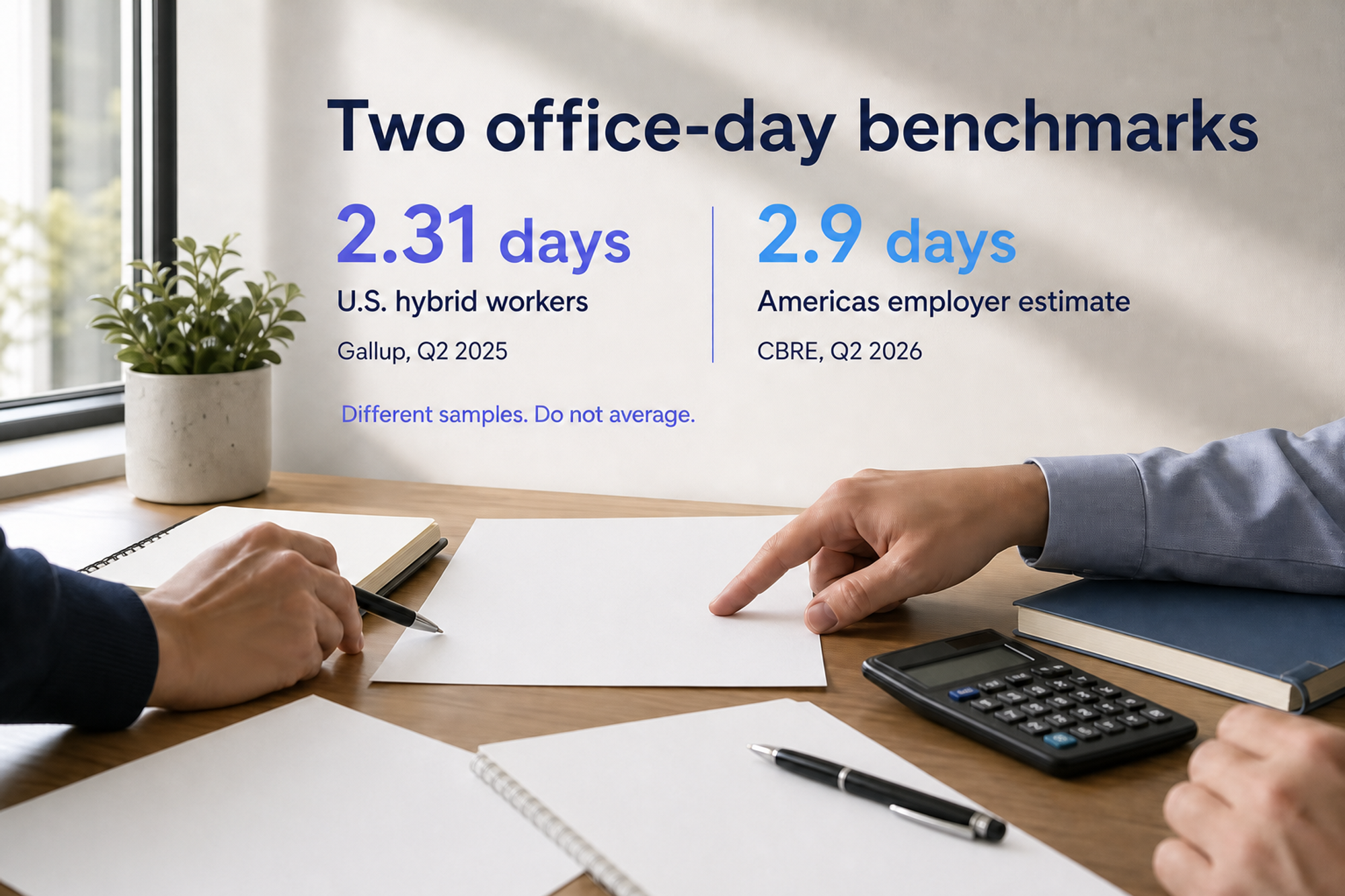
Accessible data transcription: Gallup Q2 2025 reports 2.31 office days for U.S. hybrid workers. CBRE Q2 2026 reports an employer estimate of 2.9 actual office days across Americas occupiers. Different samples should not be averaged.
2026 office-day benchmark comparison
The comparison below separates direct office-day counts from adjacent measures that are often mistaken for the same thing.
Direct office-day measures
Gallup, United States: 2.31 office days. Gallup conducted a probability-based web survey from 7 to 16 May 2025. Its topline covers 17,660 employed U.S. adults, with 4,785 respondents in the hybrid-worker segment. The time-in-office series reports a mean of 2.31 days for Q2 2025. This is a worker-reported hybrid measure, not an employer requirement.
CBRE, Americas: 2.9 actual days and 3.2 target days. CBRE published its 2026 Americas Office Occupier Sentiment Survey on 30 July 2026 using Q2 data. It reports employer estimates of actual attendance and targets. The public landing page does not disclose a respondent count, so the result should be treated as an occupier-level survey estimate, not an employee diary.
Kadence platform: closer to 2 non-cancelled bookings. Kadence platform analysis published in February 2025 says weekly bookings per user fluctuate between two and three, then move closer to two after cancelled bookings are removed. It reports about 2.5 for Australia and 1.5 for Europe. The public article does not disclose the customer count, observation dates, or a check-in requirement, so these remain booking signals rather than verified building entry.
Adjacent measures that answer different questions
Global full paid days worked from home: 1.23 days. Global Survey of Working Arrangements reports 1.23 full paid work-from-home days in late 2024 and early 2025 for college-educated workers in a balanced panel of 23 countries. Wave 4 included 16,422 workers across 40 countries. This includes people with different work arrangements and is not a hybrid-only office-day average.
United Kingdom employer requirement: three days was most common. CIPD 2025 employer research found that 51% of surveyed organizations required a minimum number of onsite days, most commonly three. The employer survey included 2,050 HR professionals and ran from 14 April to 5 May 2025. A requirement is not the same as actual attendance.
Australia weekly work pattern: 32.6% hybrid. University of Sydney TOPS surveyed 1,028 Australian adults from 1 to 12 March 2026. Among working Australians, 32.6% were weekly hybrid workers. Across all working respondents, 79.8% of weekly work hours were in the main workplace. These are prevalence and hours measures, not a count of office days for hybrid employees.
Canada hybrid time split: 55.8% spent at least half their hours outside home. Statistics Canada reported this for hybrid workers in the November 2024 Labour Force Survey reference week. It is an hours threshold for people aged 15 to 69, not a weekly office-day mean.
Great Britain hybrid prevalence: 28%. ONS hybrid work analysis found that 28% of working adults hybrid worked between 8 January and 30 March 2025. The article is based on 5,494 respondents who reported working. It identifies who hybrid works, not how many office days each hybrid worker attends.
Why the current figures disagree
The spread is not necessarily a contradiction. Most sources are measuring different things.
- Population: hybrid workers, all workers, remote-capable workers, HR leaders, or corporate real-estate occupiers.
- Signal: self-reported days, employer estimates, requirements, bookings, badge events, or hours by location.
- Time unit: a day, a full paid day of six or more hours, any onsite time during a day, or a share of weekly hours.
- Scope: one country, several Americas markets, a platform customer base, or a multi-country survey of college-educated workers.
- Observation window: the previous week, a typical week, one quarter, or a platform period that is not publicly specified.
A benchmark is only portable when those five fields are close enough to the decision you need to make.
Copy-and-use office-day benchmark card
Use this card before quoting any office-day number in a policy discussion, workplace plan, or leadership update.
- Decision: What will this number change? Examples include a team pilot, room planning, or a reporting definition.
- Metric: Actual office days, planned office days, required days, booking days, entry days, or hours onsite. Choose one.
- Population: Who is included and excluded? Record role eligibility, location, employment status, and leave treatment.
- Period: Use a defined observation window and note holidays, office closures, travel, and unusual events.
- Signal and source: Record whether the value comes from a survey, booking, badge, network, sensor, or self-reported plan.
- Coverage and sample: Record response count, missing data, participating locations, and any weighting when available.
- Limit: Write one sentence explaining what the number cannot show, such as collaboration quality or team overlap.
Copyable summary: “This benchmark measures [metric] for [population] in [geography] during [period], using [signal]. It includes [sample or coverage] and should not be used to infer [limit].”
Do not convert unlike measures into one average
Four tempting conversions create false precision:
- Do not subtract average work-from-home days from five and call the result hybrid office days unless the study confirms a five-day denominator and a hybrid-only population.
- Do not average employee reports with employer estimates. They can differ because of recall, scope, and the level at which the question was asked.
- Do not convert weekly onsite hours into office days without a documented day threshold. A person can split one day across locations.
- Do not treat a non-cancelled booking as confirmed presence unless the system verifies check-in or another arrival signal.
The existing attendance tracking methods comparison explains the blind spots of self-report, access events, network presence, reservations, sensors, observation, and combined signals.
Turn a benchmark into a four-week team test
A public benchmark can start a conversation. It should not finish the scheduling decision.
- Name the in-person purpose. List the work that may benefit from shared location, such as onboarding, equipment access, planning, or a specific handoff.
- Choose a planning range. Use the external benchmark as context, then choose a reversible starting pattern based on the team, work, and office constraints.
- Make weekly intent visible. Record the usual pattern and let people update specific weeks when plans change. Keep personal explanations in the appropriate People process.
- Check overlap and capacity. Count whether the relevant coworkers, rooms, desks, and equipment are available together. Raw headcount is not enough.
- Review after four weeks. Decide whether to continue, change the day mix, narrow the purpose, improve the workplace setup, or stop the test.

For a structured way to choose the days, use the office-day overlap worksheet. It separates availability, critical coworker pairs, and capacity guardrails.
What to report each week
Keep the reporting set small enough to support a decision:
- Planned office days: the office days people declared before the week.
- Observed office days: only when you have a clearly defined and proportionate arrival signal.
- Plan realization: observed office days divided by planned office days, using the same people and dates.
- Useful overlap: whether the people needed for the named in-person work were present together.
- Peak demand: the busiest day compared with usable workplace capacity.
Do not use attendance alone as a proxy for performance, collaboration, trust, or employee value. Keep the measure tied to the operational decision it was designed to support.
Keep weekly office intent visible
Once a team has chosen a baseline, the practical task is keeping the next week current. Share planned office days in Slack with Officedays, see who expects to be in, and use scheduled prompts for weekly updates. Keep the benchmark in the planning conversation, not as a claim that one number fits every team.
Sources and methodology
This article is a synthesis of public sources, not original Officedays research and not a universal attendance recommendation. Sources were last checked on 22 August 2026. We kept employee reports, employer estimates, platform bookings, requirements, prevalence, and hours as separate measures. We did not create a combined average.
- Gallup Workplace Q2 Topline Remote Work Trends, published 2025. Data collected 7 to 16 May 2025 in the United States. Probability-based Gallup Panel web survey of 17,660 employed adults; hybrid-worker segment n=4,785; time-in-office item reports 2.31 days for Q2 2025.
- Gallup, Hybrid Work in Retreat? Barely., published 2 September 2025. Gallup interprets the Q2 series as 46% of the hybrid workweek, equivalent to 2.3 days.
- CBRE 2026 Americas Office Occupier Sentiment Survey, published 30 July 2026 using Q2 2026 data. Americas occupier survey; the public landing page reports 2.9 actual and 3.2 target office days but does not disclose its respondent count.
- Kadence Pulse: The Magic Number Is 2, published 14 February 2025. First-party platform booking analysis across the Kadence customer base; public article does not disclose sample size or observation dates.
- Global Persistence of Work from Home, working paper posted June 2025. Wave 4 surveyed 16,422 full-time, college-educated workers across 40 countries from November 2024 to February 2025; the 1.23-day trend uses a balanced panel of 23 countries.
- University of Sydney Transport Opinion Survey, March 2026. Australian online panel survey conducted 1 to 12 March 2026 with 1,028 completed adult responses.
- CIPD Flexible and Hybrid Working Practices in 2025. UK employer fieldwork ran 14 April to 5 May 2025 with 2,050 HR professionals; employee fieldwork ran 8 January to 18 February 2025 with 5,017 working adults.
- ONS, Who Has Access to Hybrid Work in Great Britain?, released 11 June 2025. Data collected 8 January to 30 March 2025; analysis based on 5,494 working respondents.
- Statistics Canada Labour Force Survey, November 2024, released 6 December 2024 and modified 9 December 2024. Canada, population aged 15 to 69 for the hybrid-hours result; exact subgroup sample is not displayed on the release page.